 The Green Lab
One of our flagship efforts is the Black Men’s Health Study, funded by Genentech. This study investigates health disparities affecting Black men, promotes preventive care, and provides culturally tailored education and resources, with the goal of improving health outcomes and advancing health equity.
Learn moreThis M-CARES-funded project represents Phase 1 of a three-phase program that will ultimately lead to the development and testing of this tailored conversational AI tool. In this initial phase, we will explore attitudes, knowledge, and willingness to use generative AI tools (such as ChatGPT, Claude, Llama, or similar platforms) among racially and ethnically diverse populations, including individuals living with MM and MGUS. Findings from this phase will directly inform the design, cultural adaptation, and future implementation of the conversational avatar in Phases 2 and 3.
Learn more
Presented at: 2025 Health Disparities Retreat Moffitt Cancer Center
Authors:
Caseem C. Luck, MS; *Josh N. Otu; Anastasia Murphy, DRPH; **Kevin Sneed, Pharm.D.; **B. Lee Green, PhD
Moffitt Cancer Center, Population Science / Health Outcomes and Behavior
University of South Florida, Taneja College of Pharmacy
Undergraduate Student
What This Study Is About
Black men in the United States experience higher rates of heart disease and cancer, yet they are often underrepresented in health research. The Black Men’s Health Impact Initiative (BMHII) aims to change this by building one of the largest national studies focused specifically on Black men’s health and lived experiences.
Why This Matters
The project seeks to:
By centering Black men’s voices, the study reframes health research as inclusive, community‑anchored, and culturally grounded.
How the Study Works
Researchers are conducting a nationwide survey shared through trusted community networks, including:
The 20–25‑minute survey asks about daily habits, stress, support systems, and personal reflections. Recruitment relies on peer outreach and culturally familiar messengers to ensure participants feel respected and heard.
What We’re Learning So Far
Although data collection is ongoing, early participation shows:
These early lessons highlight the importance of culturally grounded strategies and peer leadership.
What This Means for the Future
BMHII demonstrates how community‑anchored research can transform health equity. By valuing lived experience alongside clinical data, the study:
Ultimately, this work supports a more just and inclusive approach to health research—one that recognizes health communication as a right and elevates community wisdom as essential evidence.

Authors:
Joshuah Otu¹; Cherell Cottrell‑Daniels, PhD, MPH²; Caseem Luck, MS¹; Brooke Bethune, BS¹; Brian Gonzalez, PhD¹; B. Lee Green, PhD¹
¹Moffitt Cancer Center, Department of Health Outcomes & Behavior
²Health Choice Network, Miami, FL
What This Study Is About
African American men face the highest rates of prostate cancer in the United States—experiencing both higher diagnosis rates and more than double the mortality risk compared to white men. While sleep problems and depression are known challenges for prostate cancer survivors, very little research has focused specifically on how these issues affect African American men.
This study explores how sleep, depression, and fatigue interact in older African American prostate cancer survivors.
Why This Matters
Understanding these relationships is important because:
The goal is to identify where support and interventions are most needed.
How the Study Was Conducted
Researchers analyzed data from 149 African American prostate cancer survivors (age 65+) who completed the PROSPECT survey. Participants answered questions about:
All measures were standardized using PROMIS scoring tools.
What We Found
Early findings show:
This suggests that fatigue may be a key driver of mental health challenges among African American prostate cancer survivors.
What This Means for Survivors
These results highlight fatigue as a critical area for intervention. Addressing fatigue—through physical activity programs, symptom management, or supportive care—may help reduce depression and improve overall well‑being.
The study also reinforces the need for racially responsive, culturally informed care to ensure African American survivors receive equitable support.
Looking Ahead
Future research should:
This work contributes to closing gaps in survivorship care and improving quality of life for African American men living with prostate cancer.

Authors:
Brooke Bethune; Marilyn Horta, PhD; Joshuah Otu; Cherell Cottrell‑Daniels, PhD, MPH; Caseem Luck, MS; Chazz Lezama‑Francois, MS; Christine Vinci, PhD; B. Lee Green, PhD
Department of Health Outcomes and Behavior, Moffitt Cancer Center, Tampa, FL
What This Review Is About
African American caregivers of cancer patients often experience high levels of fatigue, stress, depression, and sleep disturbance—yet they report lower perceived burden than other groups. This pattern may reflect cultural strengths such as spirituality, family duty, and positive reappraisal. Mindfulness‑based interventions (MBIs) have shown benefits across many populations, but remain significantly understudied among African American cancer caregivers.
Why This Matters
This review seeks to:
By integrating cultural strengths with mindfulness practices, MBIs may offer a meaningful pathway to improve caregiver well‑being and promote equitable psychosocial care.
How the Review Was Conducted
A narrative review of peer‑reviewed articles published between 2012–2025 was conducted using PubMed and Google Scholar. Twenty‑four articles met inclusion criteria. Fourteen studies examined health outcomes among African American cancer caregivers, while ten evaluated MBIs among African American caregivers of individuals with dementia, Alzheimer’s disease, or HIV/AIDS.
What We Found
Key findings include:
What This Means for the Future
African American cancer caregivers face substantial, often underrecognized distress. Culturally tailored MBIs may help caregivers better identify and manage symptoms while honoring cultural values that shape caregiving experiences. Future research should adapt and test mindfulness programs specifically within oncology to ensure equitable access to supportive care.
Authors:
Anastasia Murphy, DrPH1; Xin Tang, PhD1; Alexandria Fletcher-Duncan, PhD2; Hwanseok Choi, PhD3; Kyrel Buchanan, PhD4; Chazz Lovely Lezama-Francois, MS5; B. Lee Green, PhD1; Brian Rivers, PhD6
1 Department of Health Outcomes and Behavior, H. Lee Moffitt Cancer Center and Research Institute, Tampa, FL, USA;
2 Department of Infection Prevention and Control, H. Lee Moffitt Cancer Center and Research Institute, Tampa, FL, USA;
3 Department of Community Health & Preventive Medicine, Morehouse School of Medicine, Atlanta, GA, USA;
4 Department of Management and Marketing, University of North Alabama, Florence, AL, USA;
5 Department of Physician Assistant Studies, Morehouse School of Medicine, Atlanta, GA, USA;
6 Cancer Health Equity Institute, Morehouse School of Medicine, Atlanta, GA, USA.
What This Study Is About
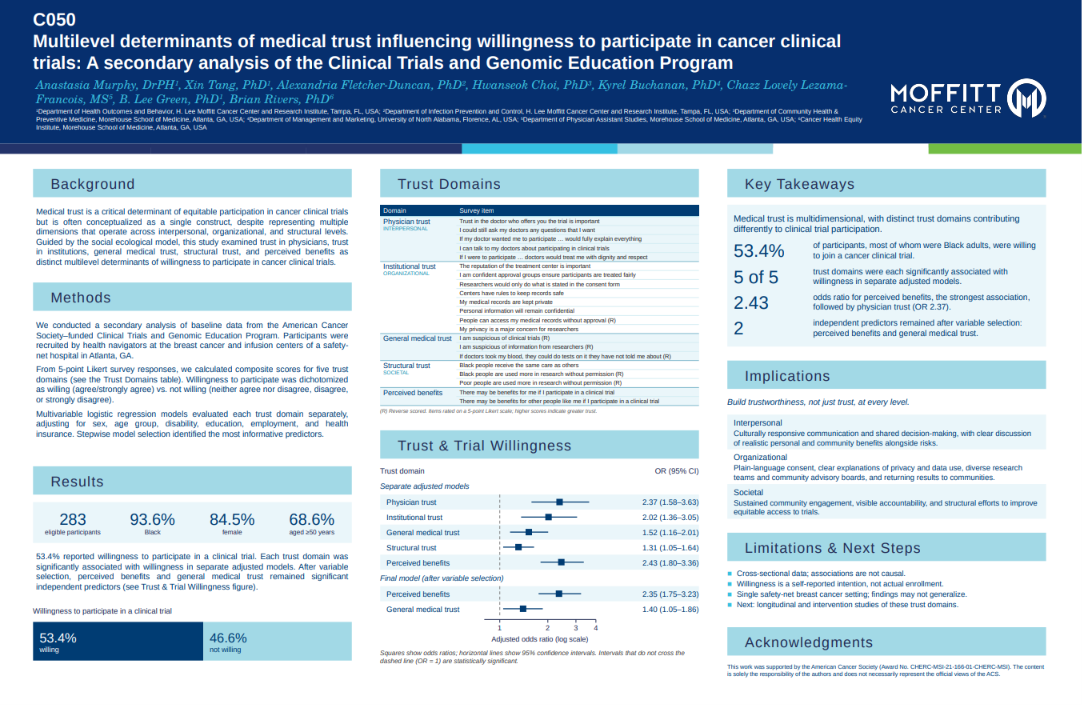
This study explored how different types of medical trust influence whether people are willing to participate in cancer clinical trials. Researchers wanted to better understand the factors that shape clinical trial participation, especially among populations that have historically experienced health disparities and underrepresentation in research. Using data from the Clinical Trials and Genomic Education Program, the study examined trust in doctors, healthcare organizations, the medical system, and broader social structures.
Why This Matters
Cancer clinical trials are essential for developing new treatments, but many people choose not to participate. One important reason is trust. Trust affects whether individuals feel comfortable enrolling in research studies and whether they believe they will be treated fairly and respectfully. Understanding the different dimensions of trust can help healthcare organizations create more equitable opportunities for participation.
The study aimed to:
How the Study Worked
Researchers conducted a secondary analysis of survey data collected from 283 participants receiving care at a safety-net hospital in Atlanta, Georgia. Most participants identified as Black adults, and many were women aged 50 years or older.
Participants answered questions about five different trust domains:
Researchers then examined how each of these trust domains related to participants' willingness to join a cancer clinical trial.
What the Researchers Found
Just over half of participants (53.4%) said they would be willing to participate in a cancer clinical trial.
Key findings included:
After accounting for multiple factors, two elements remained the strongest independent predictors:
These findings suggest that people are more likely to consider clinical trial participation when they trust the healthcare system and understand how research may benefit themselves or others.
What This Means
The study shows that medical trust is not a single idea. Trust operates at multiple levels, including relationships with doctors, confidence in healthcare organizations, and perceptions of fairness within society.
Improving participation in cancer clinical trials requires more than simply asking people to trust researchers. Instead, healthcare systems must demonstrate trustworthiness by:
What This Means for the Future
This research highlights the importance of building trust at interpersonal, organizational, and societal levels. Efforts that focus on transparency, community engagement, and culturally responsive communication may increase participation in cancer clinical trials and help ensure that research reflects the needs of diverse populations.
Ultimately, the findings suggest that increasing clinical trial participation is not only about educating people about research. It is also about creating healthcare and research environments that are trustworthy, inclusive, and responsive to community concerns.
Authors:
B. Lee Green, PhD1; Anastasia Murphy, DrPH1; Caseem C. Luck, MS1; Xin Tang, PhD1; Kristin Tillery1; Joshua N. Otu1; Shaun Stevenson2; Kevin B. Sneed, PharmD3
1 Department of Health Outcomes and Behavior, H. Lee Moffitt Cancer Center and Research Institute, Tampa, FL, USA;
2 Drexel University College of Medicine, Philadelphia, PA, USA;
3 Department of Family Medicine, University of South Florida Health Morsani College of Medicine, Tampa, FL, USA.
What This Study Is About
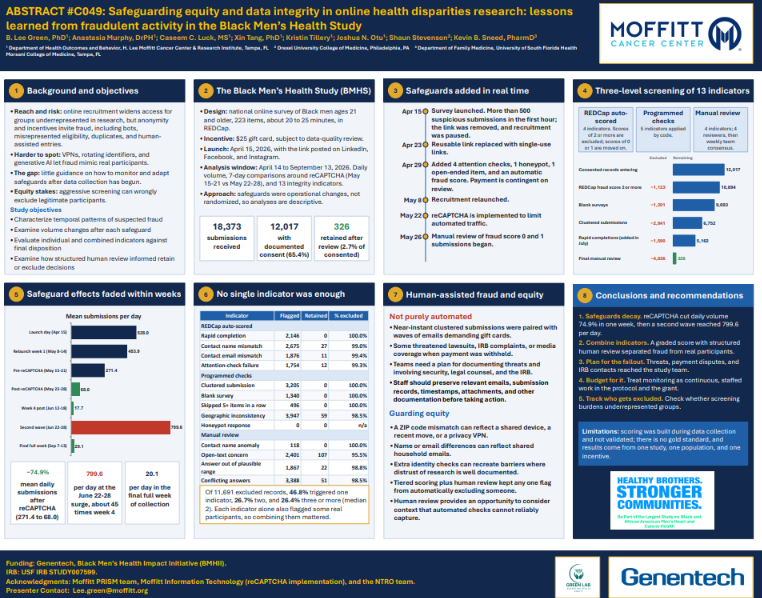
This study looked at how fake survey responses affected the Black Men's Health Study, a national online survey of Black men, and what the research team did to stop them. Researchers wanted to learn which protections worked, how long they kept working, and how to remove fake responses without wrongly turning away real participants.
Why This Matters
Online surveys make it easier to reach groups that have often been left out of health research. But because they are anonymous and often offer payment, they also attract fake responses from automated computer programs ("bots") and from people trying to collect rewards they are not eligible for. Fake data can lead to wrong conclusions. At the same time, screening that is too strict can push out the very communities researchers are trying to include.
The study aimed to:
How the Study Worked
The survey launched on April 15, 2026, and was shared on LinkedIn, Facebook, and Instagram. It was open to Black men ages 21 and older, took about 20 to 25 minutes, and offered a $25 gift card for responses that passed a quality review.
Within the first hour, more than 500 suspicious responses came in, and the survey was paused. Over the following weeks, the team added new protections:
In total, responses were checked against 13 warning signs, such as finishing the survey too quickly, giving conflicting answers, or listing a location that did not match other information.
What the Researchers Found
The survey received 18,373 submissions. About 12,000 included documented consent, but only 326 passed every check and were kept as real participants.
Key findings included:
Combining an automatic scoring system with careful review by staff was the most effective way to separate fake responses from real ones.
What This Means
The study shows that stopping fraud in online research is an ongoing process, not a one-time fix. It also shows that fairness must be part of the process. Things that look suspicious, such as a mismatched ZIP code or a shared email address, can have innocent explanations like a recent move, a shared household device, or a privacy tool.
To protect both data quality and fairness, research teams should:
What This Means for the Future
As online research grows, fake responses are becoming harder to detect. This study offers practical lessons for research teams who need to adjust their protections while a study is already underway. Because the methods were developed during this one study, future research is needed to test them in other populations and settings.
Ultimately, the findings suggest that protecting research from fraud and keeping research open to underrepresented communities must go hand in hand. Careful, fair screening helps ensure that the voices included in research are real, and that real participants are not left out.

